This is a guest post by Bart Wolbers. Bart finished degrees in Physical Therapy (B), Philosophy (BA and MA), Philosophy of Science and Technology (MS - Cum Laude), and Clinical Health Science (MS), and helps thousands of people take charge of their own health with his company.
Polluted air. Whenever I talk about that subject, people don’t really know what to say:
“No choice but to live with air pollution.”
“Everyone is breathing in toxic air so it’s not that much of a problem.”
“If polluted air really affected health the government would crack down much harder on it.”
“If you live in the city, there’s nothing you can do about an air pollution problem.”
And you know what?
You’d be entirely wrong with such statements. Heart problems, lung cancer, and Alzheimer’s are but a few of the diseases caused by air pollution.
The problem gets worse though: millions of people die every year due to air pollution (1 - 4).
Air pollution costs about 5 trillion dollars every year (107 - 108).
That’s right: $5,000,000,000,000.
Air pollution also kills more people than smoking. And yet, developed nations don’t have national marketing campaigns to reduce the harmful effects of air pollution as they do for smoking. That discrepancy is somewhat short-sighted.
What’s even more tragic is that poor people share the biggest health burden within the air pollution problem. Many poor communities are located close to airfields (5 - 7). Overflying airplanes are a major source of several air pollutants, as well as car traffic.
Highways are often located in poor neighborhoods as well.
But what are air pollutants anyway?
Well, one example is “particulate matter”. Particulate matter are tiny little particles that have a diameter 30 times as small as a human hair that you can breathe in. Lead is a second example (8 - 10). Unlike road vehicles, lead emissions are not regulated by airplane emissions.
I feel sorry for people living close to that airport...
Poor people are also hit hardest by road traffic. Why? Well, if you’re worth 5 million dollars you’re not going to live in an area where thousands of cars pass by every day.
You’ve got choice in that case…
No matter where you live, your exposure to toxic air is almost certainly excessive.
So it’s therefore time for change. It’s time you take this matter into your own hands. It’s time your health is no longer impacted by this human tragedy.
In this blog post I’ll teach you the basics about diseases caused by air pollution. I’ll specifically focus in on brain disease - the theme of this blog. I’ll also show you how to reduce your exposure levels by up to 90%.

Diseases Caused By Air Pollution: Brain Health Primer
In the following 6 sections of this blog post I will:
Explain the causes and effects of air pollution. Many people are unaware of how they’re universally surrounded by toxic air. Just understanding the problem can already make a huge difference in your health because you understand your options.
Give you a crash course on the five most important types of air pollution currently in existence. Not all pollutants are similar. Toxic mold, for example, is a big indoor danger, but mostly harmless outside. Knowing how you are exposed empowers you further.
Considers the relationship between lung disease and air pollution.
Does the same for heart disease.
Take a deep dive into air pollution and brain health. I’ll show that you cannot possibly ignore air pollution if you want to optimize brain function and health.
Lastly, I´ll give you several solutions to cut your exposure to toxic air up to 90%. While the problem might seem unavoidable and intimidating, there's light at the end of the tunnel.
Fortunately, Jordan has already prepared you for my treatment of this topic. Jordan has spoken very eloquently about how the environment affects your health in the past, in blog posts such as:
This guest blog post is thus a natural continuation of that series, this time focusing on air pollution and the brain.
Ready?
Let’s get started...

1. Air Pollution Causes And Effects Basics - A Frightening Problem
Many, many different causes of air pollution exist.
Overflying airplanes emit lead in the air, new furniture continually emits new gases into your living area, industry spreads toxins around that eventually enter your home, and traffic outside your house adds insult to injury.
At first glance, the problem seems overwhelming - a sentiment I extensively described in the introduction of this blog post.
And you’re not safe from air pollution inside your home either. Why? Well, indoor smoking, toxic mold, or dust mites (or simply dust), and carbon monoxide are common sources of indoor air pollution.
You may think: “well, in that case I’ll simply live in the middle of nowhere in a tent or RV to avoid all pollutants”
Not so quick.
Even nature herself is a source of air pollutants. Deserts emit loads of “particulate matter”, the tiny particles I mentioned before (11 - 13).
The difference between spending time in nature and living in a modern city is the extent of exposure. Most cities contain tens if not hundreds of different chemicals that are emitted into the air.
Pollution levels are much higher than in nature.
And it’s not just outdoor air quality that matters. Some estimates claim that many people spend 23 hours a day indoors, and only 1 hour outdoors. The most conservative estimates approximate that the average person spends 90% of their time inside (16 - 17).
Shocking fact:
Indoor levels of air pollutants can be a whopping 10 to 100-fold higher than outdoor levels (14 - 15). The reason for that difference is that air gets “trapped” indoors. Outdoor air often circulates indoors but is less prone to leave again.
Most people do not ventilate their homes sufficiently, which ensures that toxins keep building up indoors.
So if you experience eye irritation, or a stuffy nose 24-7, or you’ve got difficulty breathing, the reason might just be that your home or office building contains toxic air. Brain fog and poor sleep are other symptoms.
Air pollution is so dangerous because you don’t immediately notice any effects. I often call air pollution a “poison drip”. Let me explain that concept:
If your “loving” partner would add a small dose of mercury to your food every day, you’d never consciously notice. Over time that mercury would slowly kill you though. Air pollution is the same: you might only feel slightly worse after being exposed for a long period of time, but you might just think that you’re having a hard day. You don’t know a specific reason exists for why you’re feeling bad - most people never connect the dots.
The human mind is incapable of precisely registering very light damage that occurs over long periods of time. Let me give you an analogy to better understand that principle:
If you’re so unfortunate of being hit by a car, you’ll immediately notice the effects. No way out. And even though you may have broken your leg, at least you’ve identified the problem and you can take action to improve your health.
The problem with air pollution is that people don’t identify the health risk in the first place. For that reason they remain completely helpless in the face of real danger.
Real danger?
Yes…
Let me give you some statistics: Particulate matter alone causes 3-4 million deaths each single year worldwide (18 - 19). Indoor air pollution is almost as dangerous, accumulating to 1.5 - 2 million deaths per year (20 - 21).
In total, about 7 - 9 million people die prematurely because of breathing in toxic air (22 - 23). Smoking “only” kills about 5 million people per year (28 - 29).
You may think: “well, at least I’m not living in a country such as China or India. Problems are far bigger there. I live in *insert big city in a developed nation* so I’m safe”
Yes, you’re safer.
But you’re not safe...
Even in the US, 70,000 - 100,000 people die every year due to air pollution (24 - 25). In Germany, one single pollutant called “nitrogen dioxide” - which is emitted by land vehicles - causes about 6,000 - 20,000 deaths each year (26 - 27).
And remember that not everyone dies from air pollution - for every person who dies because of air pollution, 10 others have their negatively impacted. So if I breathe in toxic air for 30 years, my health and quality of life go down, even though I might die peacefully in old age.
In that case I’m not included in the air pollution mortality statistic.
So why do governments not actively tackle the air pollution problem? Simple: the more restrictive policy on air pollution becomes, the more economic growth will be inhibited. Preventing air pollution with filters on industry and air plus land traffic also costs a lot of money.
If you’re able to pollute the air somebody else will pay the price--not you.
Phrased differently, in the current system the economic costs of air pollution are simply transferred from the polluters to the people who breathe in these toxins. Of course, the category of polluters and victims often overlaps--but that’s not always the case.
Two examples:
Let’s say I own a factory and I don’t filter pollutants such as sulfur dioxide (SO2) and particulate matter. If I’m spending lots of time around that factory I’ll surely breathe in more toxic air than I’d otherwise would. But I’ll also save $500,000 or perhaps $1,000,000 per year on preventing toxins from being emitted into the air.
In that case I benefit on a net-basis.
If I’m a rich person living in Beverly Park in Los Angeles, I’m somewhat removed from the pollution of the inner city. I’ve even got a nice park next to my home that captures instead of creates air pollution.
I probably also use airplanes very frequently because I’m rich. I love holidays. The airfields I’m using are located very far away from my home though, shielding me from most of the pollution that I’ve contributed to causing.
I benefit on a net-basis once again...
Poor people thus generally cause less pollutants to be emitted in the air, while being burdened the most in their health.
And people who use their private jet? Don’t get me started.
I know my story sounds bleak up until now - and the science and politics will get even worse before it gets better.
Keep in mind that I’m not fear mongering: I’m going to show you how to reduce air pollutant exposure by up to 90% later on. But before I do, let’s first consider a couple of different air pollutants that are predominant in modern environments right now:
2. Five Different Types Of Air Pollution
In this section I’ll give you a crash course to understand where different air pollutants are coming from.
The more you know, the better you’re able to deal with the problem. Simply understanding the sources of air pollution will help you avoid exposing yourself.
For convenience sake, I’ll consider 5 types of air pollution that can be considered most important:

Particulate matter
Very small particles invisible to the naked eye can be found all around you. These particles are emitted by vehicles, industry, and as a byproduct of energy creation (wood or coal).
Particulate matter kills 800,000 - 4 million people worldwide every year (18 - 19; 30).
Nine out of ten people on this planet are breathing in polluted air. Yes, nine out of ten (31)
There’s no way to currently stop all particulate matter exposure, as road traffic and energy generation would have to stop. The economic model you and I live in is thus dependent on causing pollution.
The problem with these tiny particles is that your lungs cannot always filter them. Different sizes exist, ranging from sizes up to 10 micrometers (PM10) to a maximum-sized particle of 0.1 micrometers (PM0.1). PM2.5 is smaller than PM10, but (generally) bigger than PM0.1.
PM0.1, PM2.5, and PM10 are standardly recognized categories. And just to help your imagination:
A micrometer is a thousand times as small as a millimeter. As a point of reference, a human hair is about 70 micrometers in diameter. The most dangerous types of particulate matter, PM2.5 and PM0.1, thus have diameters of 2.5 micrometers and 0.1 micrometers.
That’s inconceivably small. You cannot possibly observe such particles with your naked eyes.
You nonetheless breathe these particles in. These particles then end up in your body. The simplest analogy to understand that principle is to imagine dust ending up in your system, preventing many physiological processes from performing optimally.
The smaller the particles are, the more damaging they become.
PM2.5 can enter your bloodstream through your lungs, for example (35 - 37). PM0.1 may travel directly to your brain through your nose when you’re breathing (32 - 34). Through that mechanism, PM0.1 can cause direct brain damage.
The closer to “civilized” society you live, the greater your exposure to particulate matter will be. Deserts are also dangerous, but contain the less harmful PM10.
The lower your exposure, the smaller your risk for getting all kinds of diseases gets. No safe exposure level exists - less is always better.
Want to learn more about this topic? Read my 22,500-word guide about particulate matter at my Nature Builds Health website.
Nitrogen dioxide
Another danger…
Nitrogen dioxide is a gas that’s produced by both traffic and energy generation (38 - 40)
If you breathe in nitrogen dioxide it negatively affects lung function. The stuff gives you acute discomfort and affects very basic physiological processes of the body (41 - 43).
Mitochondrial functioning, for example, goes down. Mitochondria are the “energy-producing” factories in your body.
Without producing energy you’d immediately die. With lower levels of energy creation, moreover, you’ll simply perform worse in daily life and you’ll become unhealthier.
Heart disease and diabetes are almost certainly caused by this air polluted, so it’s not just your lungs taking a hit (44 - 47).
Moving on to the next pollutant.
Toxic mold
Jordan has written extensively about the dangers of mold in the past, such as its role in disrupting the blood-brain barrier.
To him, the stuff is very dangerous. I fully agree with that assessment. In fact, I often tell people to run, not walk away from a building that’s infested by mold.
Fortunately, mold exposure is slowly being recognized as a health danger by the medical establishment (51 - 55). I still clearly remember that the thesis that mold caused health issues was frowned upon about 5 years ago by many medical “experts”.
Some of these experts remain skeptical, unfortunately (48 - 50).
Water damage is the most likely reason for mold infestations. Modern homes create a unique opportunity for molds in nature, in that they offer both materials in which mold can grow as well as protecting that mold from outside forces.
In nature, molds cannot grow unopposed because other organisms battle for predominance with them. A previously sterile wet wall in a house thus creates a unique opportunity for molds to grow without opposition.
Of all types of air pollution, mold is hardest to deal with because it’s often located in your living or working space.
If you’re genetically susceptible to the negative health effects of mold (your immune system will go haywire), leaving all your possessions behind while living at a mold-free location is the best diagnostic test.
Of course that step is dramatic--but no better options currently exist. The alternative is to have the issue drag on for a long time, potentially years, with worsening health over time.
The problem gets worse though: up to 50% of buildings are infested with mold in the US (56). Many buildings are made as airtight as possible today to save energy - which also creates a prison if it’s infected by mold!
Many plausible mechanisms also exist by which molds affect your health. A very strong immune response causing generalized inflammation is one example (57 - 59). That mold can also be detected in your urine after exposure (60).
The extent in which you are affected by mold mainly depends on your overall health and genetic makeup, as well as the mold species. Electromagnetic frequencies in the environment may also make molds more aggressive, adding to the danger.
Volatile Organic Compounds (VOCs)
VOCs are a gas found both inside and outside your home. Industry is a main source for VOCs outside the home, while furniture and building materials are prime sources of indoor exposure.
If you’ve got some plywood in your home, for example, that wood may be coated with material that continually emits VOCs. New furniture is similar.
Buying some new toys for your kids? These toys probably emit VOCs, unless you buy wooden toys without coating.
Your new car also emits VOCS - in fact, that new car smell is precisely caused because of these compounds. And when you’re refilling that car at the gas station, smelling benzine is a sign that you’ve just inhaled some additional VOCs.
Next:
Carbon dioxide
Everyone knows what carbon dioxide is: it’s a gas that you exhale as a byproduct of using oxygen in your body. Carbon dioxide (CO2) is also frequently posited as a causal influence in climate change.
What you might not know is that many indoor environments contain excessive carbon dioxide levels.
The reason for that excess is that indoor ventilation levels have been declining over the last century. Buildings are now built with multiple walls, three layered glass, and airtight windows.
Nothing leaves and can enter that type of buildings. If you’re staying in such a building for a long time, CO2 levels will build up if no windows are opened.
The more people are present in the same room, the quicker levels build up as well. The reason for that effect is simple: more oxygen is being consumed, and more CO2 is thus excreted.
If CO2 levels become very high, however, your wellbeing and brain performance will go down.
In nature, CO2 levels are around 400 parts per million. In classrooms or busy offices, that level can approximate thousands parts per million - no bueno. As a result, you’ll get sleepy, for example, and you’ll be more prone to call in sick or get a headache (81 - 83).
Devastating to your health? No.
Inconvenient and unnecessary? Yes!
That’s the crash course into 5 important air pollutants...
Now that you understand that air pollutants are very pervasive in the modern world, let’s consider what types of diseases they cause.
If you’d like to know more about 13 other different types pollutants, in much greater detail than discussed here, then read my guide on surviving the health effects of air pollution.
I’ll begin with lung disease:
3. Respiratory Diseases Caused By Pollution

You may think: “Why care about respiratory disease in the first place?”
You’re reading a blog about brain health right?
Sure. But your lung function is closely intertwined with brain performance. In fact, the worse your breathing becomes, the worse brain performance also gets, and vice versa (84 - 87).
Breathing techniques can immediately improve brain performance, for instance (85 - 86). Better breathing capacity also allows you to stay cognitively flexible in old age, for example. So optimizing your breathing pattern affects both short-term and long-term brain function.
Now, breathing in polluted air - many of the toxins I’ve mentioned in the previous section - also directly causes many airway and lung diseases (88).
An example of such a disease are asthma, in which airways become tighter due to swelling and the increased presence of thick fluid (mucus). Another example is COPD (Chronic Obstructive Pulmonary Disease). That disease is also characterized by “obstruction” of the airways, as the name already suggests.
Even during pregnancy, air pollution already affects the eventual lung health of the newborn (89). If higher air pollutant exposure occurred in the mother, lung function will also be lower in children.
In adults too, greater air pollutant exposure leads to lowered lung function (91). By inference, lower lung function also leads to a cognitive decline (93 - 96).
The worst-case scenario is that you’ll end up with lung cancer with more exposure (92). The best-case scenario is that your brain performance goes down.
An inconvenient truth…
Now that I’ve laid out the case for declines in lung function, let’s consider heart disease in relation to air pollution:
4. Heart Disease Caused By Air Pollution

Surely heart health will have nothing to do with the health of your brain, right?
Wrong!
In fact, a healthy heart is central to keeping your brain performing well into old age (97 - 100).
The link between heart and blood vessel diseases and air pollution exposure is also extremely well established (101 - 106) If you’re in a frail state, even short-term exposure to air pollutants can trigger a cardiovascular event such as a heart attack (101).
Inhaling an air pollutant such as particulate matter also almost immediately increases your blood pressure, heart rate, strain on the blood vessels, and coagulation (which can damage the walls of vessels) (101).
Of the five air pollutants I’ve treated before, particulate matter and nitrogen dioxide are most damaging for heart health (104 - 105). Remember that car traffic is one main source of these two pollutants. Energy creation is another one.
Simply living near a busy road already increases your risk of “atherosclerosis”, a narrowing of your blood vessels due to plaque buildup (102). That plaque can eventually fully constrict a blood vessel, possibly leading to a heart attack or stroke.
Unfortunately, even in progressive political geographies such as the European Union standards are not stringent enough (102). You’ll thus have to take matters into your own hands...
The longer you’re exposed to air pollution, the more damage being done to your heart. In other words, the causal relationship is linear (103).
If you’re old, very young, or have existing heart conditions, you’re more at risk (104). If government officials thus claim that smog is innocent, they’re either lying or delusional (109).
Air pollution has enormous effect on your overall health.
At a very fundamental level, for instance, air pollution may also increase your susceptibility to psychological stress (105). Stress, in turn, affects brain health and performance yet again…
So we’ve come full circle once more..
Now that I’ve laid out the link between air pollution and heart health, let’s now consider the effects on the brain itself:
5. Air Pollution and Brain Health

Brain health.
Finally...
The reason you’re reading on Optimal Living Dynamics in the first place.
By now you can guess the outcome: air pollution contributes to brain disease (110 - 111).
It’s not just elderly people who are impacted by air pollutants - even kids’ psychological and motor development is negatively affected (110).
The study of the interaction of air pollution and brain health is actually far more recent (111). In other words, the connection to lung and heart problems has been well known for decades, while the connection to brain disease is relatively novel.
Unfortunately, it’s now getting clear that air pollution increases your risk for getting strokes (111 - 115). During a stroke, a part of the human brain dies off due to a lack of oxygen. Both a bleeding and a plaque buildup can cause that condition.
Some contrary evidence does exist though, so the relationship cannot be definitively established (yet) (116 - 117). Lots of discussion does still exist on the exact causes of that risk.
Nevertheless, leaving behind the worst-case scenario of a stroke, several brain areas have been implicated in air pollution exposure (118).
These brain areas include the cortex and subcortical regions, which are responsible for higher-order cognitive functions as well as motivation and learning. The functioning of these brain areas is negatively affected.
White matter in the brain is also influenced in a bad way (118). White matter contains lots of myelin, which increases nerve conduction speed. If you’re interested in learning more about that topic, read Jordan’s excellent guide about building myelin in the brain.
Your brain additionally becomes gets more inflamed with greater exposure, for instance (122).
Over time, moreover, higher exposure to air pollution contributes to cognitive impairment (119). Even indoor air pollution such as that originating from indoor cooking can be enormously problematic in that case.
(Quick tip: Always make sure that indoor cooking areas are properly ventilated).
And no, before you ask: Cognitive impairments are not just a problem for elderly people-- even adults run into trouble (120 - 121)..
Executive functions such as planning or memory can deteriorate in your brain, for instance (129 - 131). Result? The more children and young adults are exposed to PM2.5, the greater the likelihood that they’ll be involved in crime (due to a lower inability to inhibit their baser impulses) (130).
Yes, even crime rates are affected by air pollution. The same is true for overall behavioral problems (131).
The end-result over years and decades of exposure is an increased risk for dementia and Alzheimer’s (123 - 128). Beta amyloid plaques, one of the main hypotheses as a causative agent in Alzheimer’s disease, are increasingly present with greater air pollutant exposure.
So overall, brain health is affected at many levels, either directly or through lowered lung and heart health.
Moving on to the last topic:
6. Air Pollution Solutions
Scared yet?
Had enough of my (justified) fear-mongering? You should be!
Don’t worry, I’ll give you solutions to deal with the problem as well. In fact, in this section I’ll give you a step by step guide on how to reduce your exposure by 90 - 95% - even if you’re living in the city.
Before I do though, let’s first get an impression of how you’re doing in the air pollution department. Consider the following air quality index map that contains real time data on thousands of cities all over this planet.
Consider Amsterdam, for example, the capital of the country I'm living in:
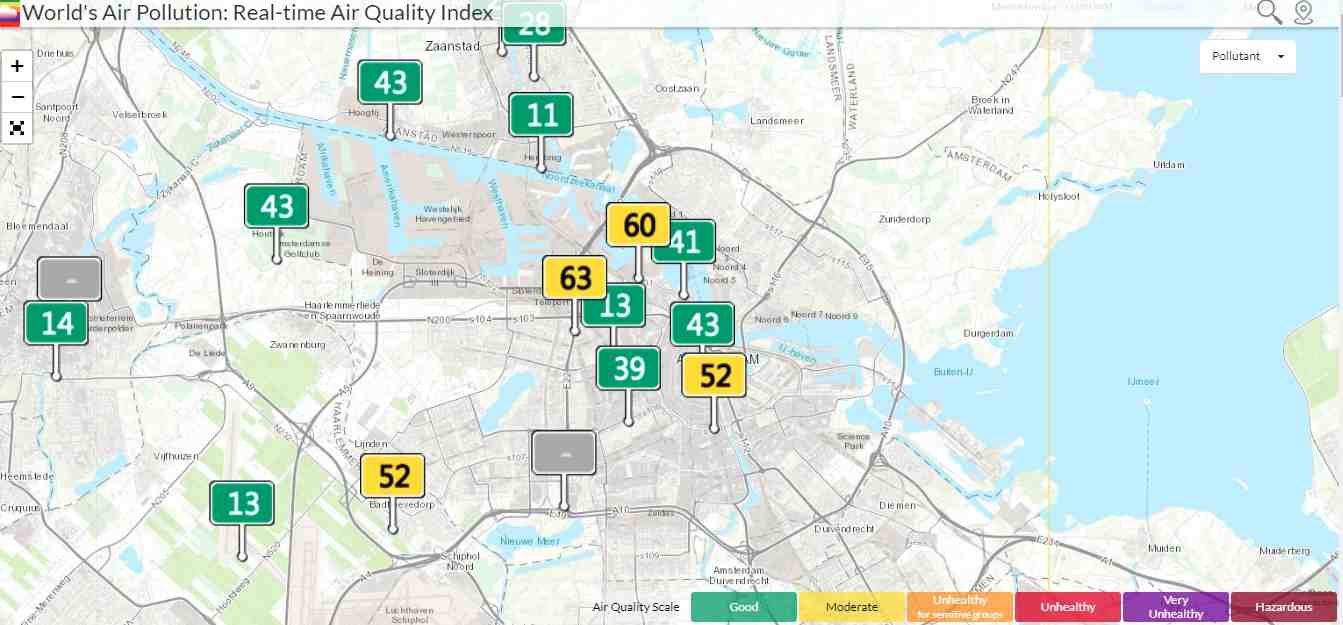
Not perfect, but reasonable.
Compare Amsterdam to Mexico City, the capital of Mexico:

Mexico City, as you can see, is not that clean.
So if you’re living in Mexico City, you have to apply more of the strategies listed below to mitigate your risk.
Again, check your own risk at that air quality index map to get a general impression before you start reading this section.
Done? Let’s then begin:
Avoid polluted areas.
This one is really simple. By not traveling in rush hour, for instance, you dramatically cut down on your exposure. Also make sure to exercise outside the city in nature (132). That way you can potentially halve your exposure to air pollutants.
Don’t believe me? Just look at the map you’ve just searched yourself on: some areas are way less polluted than others in the same city. Another possibility is to exercise away from busy roads and airports.
Fortunately, the benefits of exercise still outweigh those of the harm done by air pollution (133). Only for longer workouts or in more susceptible individuals that may not be the case.
Use an air purifier.
Why? Remember I mentioned people only spend 1-2 hours outside during the day? The remaining 22 - 23 hours are thus spent inside.
Also recall that indoor levels of air pollution are much higher than outdoor levels. Indoor air quality are thus the most important to control.
Air purifiers therefore become a must in polluted areas. Air purifiers can remove up to 90% of pollutants from an environment when used correctly.
I recommend the Coway Air purifier for small and medium-sized rooms, up to ~500 feet (~50 square meters). For rooms up to 1,300 foot (120 square meters), use the Alen Breathesmart.
I’ve reviewed many different air purifiers on my blog, by synthesizing lots of existing data. The two air purifiers listed above have the best price to quality relationship and filter the air very efficiently. These purifiers will also keep working perfectly year after year.
Make sure to replace filters as prescribed, otherwise filtering will not be as effective. And keep your windows closed (most of the time), otherwise air purifiers won’t do their job.
Ventilate the building you’re spending time in. Yes, that means that you need to open your windows sometimes. The reason is that you’ll want CO2 to exit the building, and fresh oxygen (O2) to come in.
Late nights and early mornings are generally the best times to open up your windows, as well as between rush hour periods. During these times air pollution levels are (generally) lowest.
AIr pollution generally builds up during the day, so 6 PM is a bad time to ventilate...
Hire a mold expert if necessary.
Most people simply don’t have a clue on how to treat a very pervasive problem such as mold, and what to look for. In the best case scenario your interventions are useless--in the worst case scenario you’re making the problem worse.
Using bleach on mold, for example, might simply mask the problem for a while and give you a false sense of security that the problem is “solved”. Vinegar is equally deceptive.
Not even an air purifier will not fix your mold problem by the way. There’s one simple rule with regarding to mold if you’re susceptible: The mold needs to be fully removed from your environment.
How? Hire an expert, unless you’ve read a couple of books on the topic.
Temporarily move if necessary, or live in a tent in your garden. Mold can wreck your health and set you back for years (in the worst case scenario).
Some people can live in a moldy environment and feel fine though...
Build up tolerance with exercise.
You may think: “well, it’s polluted outside today. I just checked the air quality map. So I’ll skip exercise for now. Maybe tomorrow.”
Not too quick.
The benefits of exercise still outweigh the risks of pollution in general. Exercise also builds your brain, heart, and lung health (133 - 134).
The higher your exercise tolerance, the more leeway you’ve got. And if you’re really scared of the health effects of air pollution (which I can imagine by now), I recommend putting that air purifier on max and doing 5 - 30 minutes of bodyweight exercises.
No excuses allowed.
If necessary, use an anti-dust respirator, which cuts out particles (but not gases) from entering your lungs.
Have indoor and outdoor vegetation capture as much toxins as possible.
The best line of defense? Don’t let pollutants enter your home or office in the first place. Vegetation accomplishes that goal.
The underlying principle as of why these plants work is because they simply capture air pollutants from the air before they enter your home. Vegetation is often called a “living wall” for that reason.
Pine trees, yews, ivys, and Japanese maples are great options (135 - 144). Pines even function well in the wintertime.
Combine high pine trees with conifers at ground level for the best results, for example. The more layers of wall, the greater the protection (but also the higher the financial costs).
Covering your roof with pines also helps .In fact, covering the entire roof with pines captures over 90 kilograms (200 pounds) of particulate matter each year (135).
Shocking but true.
Indoor plants can also capture some of the circulating air pollutants such as particulate matter. Make sure to use a HEPA vacuum cleaner to remove these toxins from the indoor plants.
You cannot fully rely on indoor plants to filter the air and provide oxygen though, as you’d need a lot of vegetation for that purpose. Your living room would essentially need to become a small jungle - a lofty goal for people who want to optimize every aspect of their lives, but a step too far for me.
I suspect you’re the same...
Go organic - inside your home
No, I’m not talking about organic food, although such food is a great choice for your overall health.
I’m talking about organic furniture...
Remember these VOCs I talked about? If you buy the very cheapest indoor furniture, it’s almost certain that coatings or other substances have been applied to make the objects look better.
Organic or more natural materials simply means buying solid wooden furniture and stone floors.
Yes, even your house becomes “paleo” that way. Anything added to natural materials that can offgas is more dangerous. Flame retardants are an example.
Many natural indoor materials are available though. You can buy paint for your house that’s low in VOCs. You can buy cushions made from pure cotton. You can even buy couches without flame retardants.
Of course, such furniture is generally pricey--I cannot afford that stuff either (yet)--but your health will eventually thank you for it…

So that’s it. Everything you need to know about protecting your brain from air pollution.
The lesson I hope you take way from this blog?
A health problem that may sound unsurmountable in the very beginning - even hopeless - may be overcome by strategic thinking.
You can do it. Take charge of your health today!
You deserve it. Your brain deserves it. Your life deserves it...
Enjoy This Article? You Might Also Like This FREE Food Guide for Optimal Brain and Mental Health!
References:
(1) https://www.who.int/airpollution/en/
(2) https://www.nature.com/articles/d41586-019-01234-2
(3) http://time.com/4836660/air-pollution-health-death-epa/
(4) https://psmag.com/environment/air-pollution-kills-more-people-than-smoking
(5) https://www.ncbi.nlm.nih.gov/pubmed/20383366
(6) https://www.ncbi.nlm.nih.gov/pubmed/30021333/
(7) https://www.ncbi.nlm.nih.gov/pmc/articles/PMC5650728/
(8) https://www.ncbi.nlm.nih.gov/pmc/articles/PMC3230438/
(9) https://www.ncbi.nlm.nih.gov/pmc/articles/PMC5338738/
(10) https://www.ncbi.nlm.nih.gov/pubmed/27494542
(11) https://www.ncbi.nlm.nih.gov/pmc/articles/PMC3230430/
(12) https://www.ncbi.nlm.nih.gov/pmc/articles/PMC6261329/
(13) https://www.ncbi.nlm.nih.gov/pubmed/18854705
(14) https://www.epa.gov/report-environment/indoor-air-quality
(15) https://www.ncbi.nlm.nih.gov/pmc/articles/PMC5707925/
(16) https://www.ncbi.nlm.nih.gov/pmc/articles/PMC2443227/
(17) https://www.ncbi.nlm.nih.gov/pmc/articles/PMC1892115/
(18) https://www.thelancet.com/journals/lanplh/article/PIIS2542-5196(18)30288-2/fulltext
(19) https://www.ncbi.nlm.nih.gov/pmc/articles/PMC4651962/
(20) https://www.ncbi.nlm.nih.gov/pubmed/15636485
(21) https://www.ncbi.nlm.nih.gov/pmc/articles/PMC5615585/
(22) https://www.ncbi.nlm.nih.gov/pmc/articles/PMC6326158/
(23) https://www.pnas.org/content/115/38/9592
(24) https://e360.yale.edu/digest/us-air-pollution-deaths-nearly-halved-over-two-decades
(26) https://phys.org/news/2018-03-german-deaths-nitrogen-dioxide.html
(28) https://www.ncbi.nlm.nih.gov/pmc/articles/PMC4851760/
(29) https://www.ncbi.nlm.nih.gov/books/NBK343639/
(30) https://www.ncbi.nlm.nih.gov/pubmed/22194192
(31) https://airqualitynews.com/2018/05/02/who-links-7-million-deaths-to-particulate-pollution/
(32) https://www.ncbi.nlm.nih.gov/pubmed/15204759
(33) https://www.ncbi.nlm.nih.gov/pmc/articles/PMC1570474/
(34) https://www.ncbi.nlm.nih.gov/pmc/articles/PMC3804071/
(35) https://www.ncbi.nlm.nih.gov/pubmed/10469026
(36) https://www.ncbi.nlm.nih.gov/pubmed/28303426
(37) https://www.ncbi.nlm.nih.gov/pubmed/19203021
(38) https://www.epa.gov/no2-pollution
(39) https://www.environment.gov.au/protection/publications/factsheet-nitrogen-dioxide-no2
(40) https://www.greenfacts.org/en/nitrogen-dioxide-no2/
(41) https://www.ncbi.nlm.nih.gov/pmc/articles/PMC1308370/
(42) https://www.ncbi.nlm.nih.gov/pubmed/25791864
(43) https://www.ncbi.nlm.nih.gov/pmc/articles/PMC1746124/
(45) https://www.ncbi.nlm.nih.gov/pubmed/29616776
(46) https://www.ncbi.nlm.nih.gov/pubmed/29615239
(47) https://www.ncbi.nlm.nih.gov/pubmed/29319630
(48) https://www.ncbi.nlm.nih.gov/pubmed/28299723
(49) https://www.ncbi.nlm.nih.gov/pubmed/28453304
(50) https://www.ncbi.nlm.nih.gov/pmc/articles/PMC5554125/
(51) https://www.ncbi.nlm.nih.gov/pmc/articles/PMC5545575/
(52) https://www.ncbi.nlm.nih.gov/pubmed/28421079
(53) https://www.ncbi.nlm.nih.gov/pubmed/27986496
(54) https://www.ncbi.nlm.nih.gov/pmc/articles/PMC5603479/
(55) https://www.ncbi.nlm.nih.gov/pmc/articles/PMC5834427/
(56) https://www.who.int/airpollution/guidelines/dampness-mould/en/
(57) https://www.ncbi.nlm.nih.gov/pubmed/26010737
(58) https://www.ncbi.nlm.nih.gov/pubmed/28640227
(59) https://www.ncbi.nlm.nih.gov/pubmed/28119688
(60) https://www.ncbi.nlm.nih.gov/pubmed/24368325
(81) https://www.ncbi.nlm.nih.gov/pubmed/26273786
(82) https://www.ncbi.nlm.nih.gov/pubmed/26273786
(83) https://www.ncbi.nlm.nih.gov/pubmed/24920413
(84) https://www.ncbi.nlm.nih.gov/pmc/articles/PMC4374650/
(85) https://www.ncbi.nlm.nih.gov/pubmed/8132419
(86) https://www.ncbi.nlm.nih.gov/pubmed/1938166
(87) https://www.ncbi.nlm.nih.gov/pmc/articles/PMC5226946/
(88) https://www.ncbi.nlm.nih.gov/pmc/articles/PMC4740163/
(89) https://www.ncbi.nlm.nih.gov/pmc/articles/PMC6033955/
(90) https://www.ncbi.nlm.nih.gov/pmc/articles/PMC5823896/
(91) https://www.ncbi.nlm.nih.gov/pubmed/8325268
(92) https://www.ncbi.nlm.nih.gov/pubmed/26761628
(93) https://www.ncbi.nlm.nih.gov/pubmed/16484809
(94) https://www.ncbi.nlm.nih.gov/pmc/articles/PMC3092022/
(95) https://www.ncbi.nlm.nih.gov/pubmed/7582303
(96) https://www.ncbi.nlm.nih.gov/pmc/articles/PMC3086642/
(97) https://www.ncbi.nlm.nih.gov/pmc/articles/PMC3780407/
(98) https://www.ncbi.nlm.nih.gov/pmc/articles/PMC4294149/
(99) https://www.ncbi.nlm.nih.gov/pmc/articles/PMC3375144/
(100) https://www.ncbi.nlm.nih.gov/pubmed/11460173
(101) https://www.ncbi.nlm.nih.gov/pubmed/29470659
(102) https://www.ncbi.nlm.nih.gov/pmc/articles/PMC5963518/
(103) https://www.ncbi.nlm.nih.gov/pmc/articles/PMC5630425/
(104) https://www.ncbi.nlm.nih.gov/pmc/articles/PMC4112067/
(105) https://www.ncbi.nlm.nih.gov/pmc/articles/PMC5721790/
(106) https://www.ncbi.nlm.nih.gov/pubmed/29199599
(108) http://time.com/4484027/air-pollution-economic-toll-world-bank/
(109) https://www.ncbi.nlm.nih.gov/pmc/articles/PMC5560907/
(110) https://www.ncbi.nlm.nih.gov/pmc/articles/PMC6132565/
(111) https://www.ncbi.nlm.nih.gov/pmc/articles/PMC5836577/
(112) https://www.ncbi.nlm.nih.gov/pmc/articles/PMC5615628/
(113) https://www.ncbi.nlm.nih.gov/pubmed/28930181
(114) https://www.ncbi.nlm.nih.gov/pubmed/29402072
(115) https://www.ncbi.nlm.nih.gov/pubmed/28930181
(116) https://www.ncbi.nlm.nih.gov/pmc/articles/PMC5135592/
(117) https://www.ncbi.nlm.nih.gov/pubmed/29310044
(118) https://www.ncbi.nlm.nih.gov/pubmed/30008171
(119) https://www.ncbi.nlm.nih.gov/pubmed/30543549
(120) https://www.ncbi.nlm.nih.gov/pmc/articles/PMC6126300/
(121) https://www.ncbi.nlm.nih.gov/pmc/articles/PMC5499513/
(122) https://www.ncbi.nlm.nih.gov/pubmed/29874918
(123) https://www.ncbi.nlm.nih.gov/pmc/articles/PMC6138768/
(124) https://www.ncbi.nlm.nih.gov/pubmed/22523504
(125) https://www.ncbi.nlm.nih.gov/pmc/articles/PMC6138763/
(126) https://www.ncbi.nlm.nih.gov/pubmed/30080655
(127) https://www.ncbi.nlm.nih.gov/pmc/articles/PMC4876896/
(128) https://www.ncbi.nlm.nih.gov/pmc/articles/PMC6138768/
(129) https://www.ncbi.nlm.nih.gov/pmc/articles/PMC5893638/
(130) https://www.ncbi.nlm.nih.gov/pubmed/29234991
(131) https://www.ncbi.nlm.nih.gov/pubmed/27350569
(132) https://www.ncbi.nlm.nih.gov/pubmed/24174304
(133) https://www.ncbi.nlm.nih.gov/pmc/articles/PMC1402378/
(134) https://www.ncbi.nlm.nih.gov/pmc/articles/PMC2920084/
(135) https://www.ncbi.nlm.nih.gov/pubmed/29852441
(136) https://www.ncbi.nlm.nih.gov/pubmed/24607629
(137) https://www.ncbi.nlm.nih.gov/pubmed/22554531
(138) https://www.hindawi.com/journals/tswj/2015/935942/
(139) https://www.ncbi.nlm.nih.gov/pubmed/27646446
(140) https://www.ncbi.nlm.nih.gov/pubmed/25597660
(141) https://www.ncbi.nlm.nih.gov/pubmed/29710557
(142) https://www.ncbi.nlm.nih.gov/pubmed/26506104
(143) https://journals.plos.org/plosone/article?id=10.1371/journal.pone.0177539
(144) https://journals.plos.org/plosone/article?id=10.1371/journal.pone.0179840